 T-Agent
Travel GEO with T-Agent, from topics to content
Give T-Agent your brand materials, target markets and traveler needs to generate brand, category and long-tail topics, then create content for the questions your team approves.
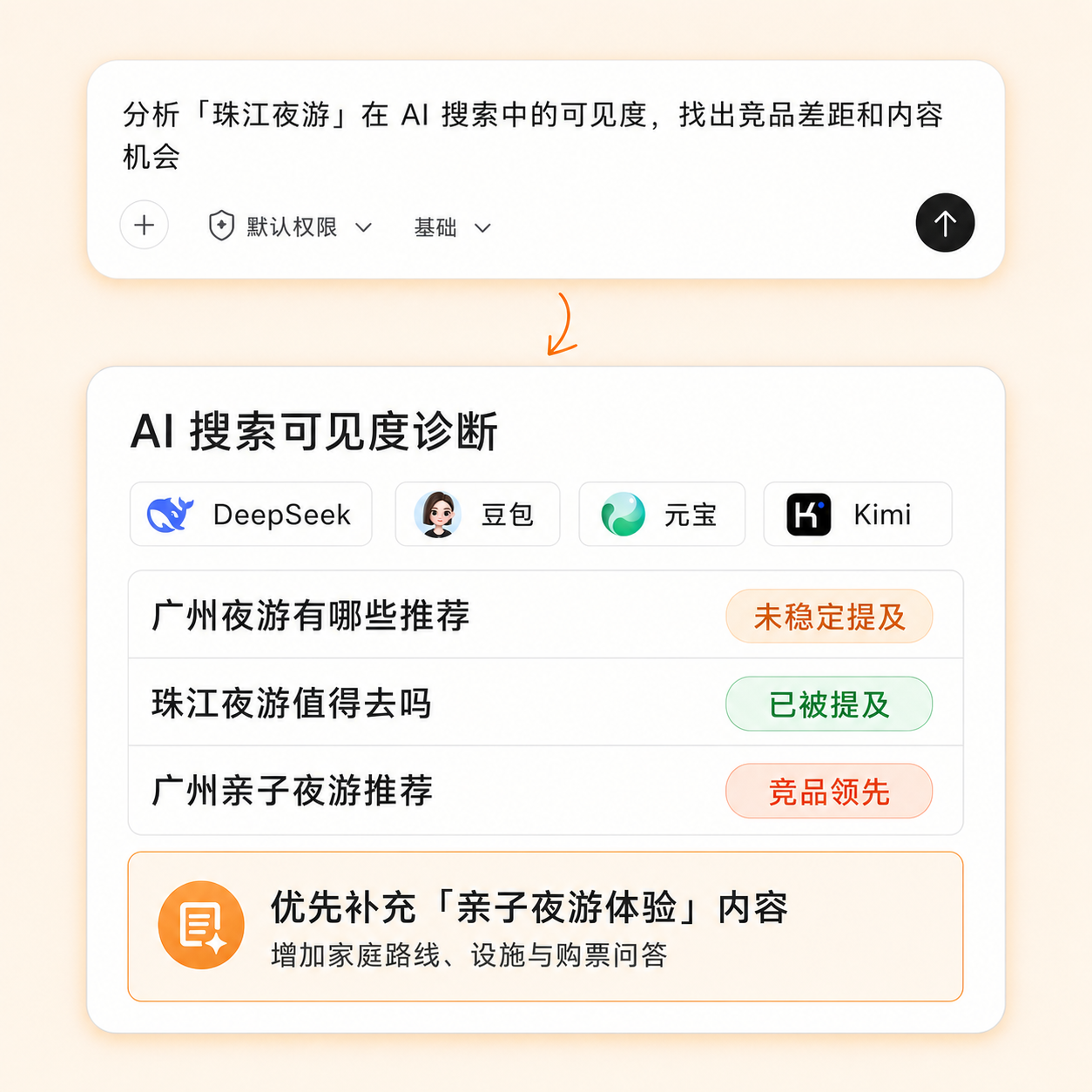
When travel brands first try generative engine optimization (GEO), they often treat topics like SEO keywords: a brand name, destination, attraction recommendations and a few competitors. That becomes their topic pool.
Once the work begins, two problems appear. Operators do not know which questions deserve ongoing observation. And when an opportunity emerges, they still have to gather information, choose an angle and write the content. T-Agent's GEO workflow starts with these tasks: generate three useful types of topics, then create content around the questions the operator confirms.
Travelers rarely type just one word into AI search. They describe their companions, available time, budget and concerns:
- Which attractions in Osaka are suitable for families?
- Where can I take children in Osaka on a rainy day?
- With only half a day, which family attractions in Osaka do not require frequent transfers?
- On my first trip to Japan, how can I buy attraction tickets if I do not speak Japanese?
The first question is broad. The others get progressively closer to a real decision. Operators can give T-Agent brand introductions, product materials, target markets and audience information to generate brand, category and long-tail scenario topics. After confirming that the questions fit the products and business goals, they can move into monitoring and content creation.
Distinguish three kinds of topics
Start with brand, category and long-tail scenario topics. They address different stages of a traveler's journey, so concentrating on only one type leaves gaps.
Brand topics: check what travelers see before buying
Brand topics are questions travelers ask when they already know your business.
Common examples include:
- Is attraction X worth visiting?
- Is cruise X suitable for children?
- What is the difference between attraction X and attraction Y?
- Are tickets for X refundable?
- Does X offer Chinese-language service?
These questions help verify information before conversion. A traveler is already considering your product. If AI gets opening hours, prices, transport, facilities or refund rules wrong, more content elsewhere will not necessarily recover that opportunity.
Keep a small set of common questions covering value, suitable audiences, competitor comparisons, prices and services, purchasing and after-sales support.
Category topics: enter the traveler's shortlist
Category topics come from travelers without a firm brand preference. They know what they want but have not chosen a provider.
Common patterns include:
- Destination + attraction recommendations
- Category + which provider is good
- Audience + where to go
- Situation + how to plan
- Need + how to solve it
For example:
- Recommended family attractions in Osaka
- Which travel agency should I choose for a Kyoto day trip?
- Which relaxed itineraries in Japan suit older travelers?
- Where can I go in Kansai on a rainy day?
- How can overseas visitors buy attraction tickets in Japan?
These questions affect whether new travelers discover a brand. AI-generated shortlists can influence which providers people research, compare and visit next.
Long-tail scenarios: identify more specific travel needs
Long-tail topics add conditions to a category question, making it sound more like something a traveler would actually ask.
| Condition | Example travel question |
|---|---|
| Audience | Which Osaka attractions are easy to visit with preschool children? |
| Time | How should I spend half a day in Kyoto without rushing? |
| Budget | Which evening activities in Osaka cost under ¥10,000 for two people? |
| Situation | Which indoor attractions suit a rainy-day visit with my parents? |
| Concern | Will buying attraction tickets on site be difficult if I do not speak Japanese? |
| Comparison | Is cruise X or cruise Y better for night views? |
| Location | Which family attractions are within 30 minutes of Osaka Station? |
Each question may address a smaller audience, but the intent is clearer. Dozens of questions with real decision value can reveal more content opportunities than repeatedly watching one broad term.
Why long-tail topics deserve attention
Competition tends to concentrate around broad topics.
When asked for attractions in Japan or must-see places in Osaka, AI can readily list famous attractions, large platforms and products repeatedly covered by media. A new brand or regional product needs sustained credible content and external references to earn consistent recommendations for those questions.
But travelers rarely stop at a broad list. They ask further questions:
- Where can we go with two children and only three hours?
- Which attractions require reservations and help us avoid queues?
- Which facilities and transport options suit a wheelchair user?
- What can a family do after 8 p.m.?
These questions may have smaller search audiences, but they are closer to itinerary and purchase decisions. Answers require evaluating fit, complete product information and real cases or third-party sources, rather than simply listing the best-known brands.
Broad topics help observe visibility; long-tail questions help identify specific opportunities. Both have a role.
Ask T-Agent for an initial topic pool
Do not make every question a brand topic. Brand questions show how AI describes you when a traveler already has you in mind. They are less useful for discovering new traveler needs.
For the first topic pool, specify the source materials, market and quantity:
Using the brand introduction, product materials and audience information I provide, generate 30 travel GEO topics. Divide them into brand, category and long-tail scenario questions. Brand questions should check facts and purchase concerns; category questions should explore potential shortlists; long-tail questions should prioritize audience, time, budget, weather and travel restrictions. Return candidate questions first, without writing articles.
T-Agent organizes the candidates into the three groups. Operators should then check whether each question fits real products and target travelers, whether the necessary evidence exists, and whether monitoring or creating content for it would be useful.
Begin with a small pool to establish a baseline:
- Keep a few brand questions to check product facts and conversion risks.
- Use category questions to observe which brands and sources appear in the target market.
- Focus the research on concrete long-tail needs.
Reuse question patterns
When a team runs out of topic ideas, begin with common traveler question patterns and substitute the actual product and audience:
| Pattern | Example |
|---|---|
| Destination + category + recommendation | Which family attractions do you recommend in Osaka? |
| Category + best provider | Which agency offers a good Kyoto day trip? |
| Audience + destination + how to choose | How should I choose a Hakone itinerary for older travelers? |
| Situation + where to go | Where can I take children in Osaka when it rains? |
| Concern + what to do | How can I buy attraction tickets in Japan without speaking Japanese? |
| Budget + product | Which Osaka evening activities cost under ¥10,000? |
| Product A + product B + comparison | Is cruise X or cruise Y better for families? |
| Category + alternative | What family activities are there in Osaka besides theme parks? |
| Location + service + how to choose | How should I choose a half-day tour near Osaka Station? |
Useful questions sound like something a traveler would ask a guide, support agent or AI assistant.
Turn selected topics into content
Building the question list is just the beginning. The full workflow has six steps:
- Generate candidate questions from brand, product, market and audience materials.
- Have an operator select questions that fit the business and add them to the confirmed set.
- Sample AI platforms to see whether they mention the brand and whom they recommend.
- Examine the content and facts cited when competitors are recommended.
- Choose a specific topic and ask T-Agent to write from confirmed materials.
- Check product facts before publication, then observe changes in mentions and citations.
Suppose AI recommends a competitor for “Where can I take children in Osaka on a rainy day?” but omits your indoor attraction. Before repeating “family,” “rain” and “Osaka” throughout an article, examine the competitor's answer:
- Why did AI recommend it?
- Did it cite the official website, media coverage or traveler guides?
- Does it clearly describe suitable ages, visit duration, indoor facilities and purchasing?
- Are you missing factual materials, or a page that explains those facts?
Once the gap is clear, give T-Agent the question and existing materials:
Write content answering “Where can I take children in Osaka on a rainy day?” Use confirmed product materials. Answer the question directly, then explain suitable ages, suggested visit duration, indoor facilities, transport and ticket purchasing. Do not add unsupported information; list anything I need to confirm.
T-Agent organizes the angle and draft around the topic. Brand questions suit product facts, FAQs and comparisons. Category topics suit selection guides and shortlists. Long-tail scenarios suit direct answers for a particular audience or travel situation. Operators check prices, facilities, opening hours and refund rules before choosing where to publish.
A topic then becomes a basis for content work rather than another row in a monitoring report. T-Agent's GEO plugin can also sample AI visibility on DeepSeek, Doubao, Yuanbao and Kimi, recording brand mentions, rankings, sentiment, competitors and cited sources. The business owner still confirms monitoring scope, publication and product facts such as prices, facilities and refund rules.
Common mistakes
- Only tracking broad terms. These matter, but competition is concentrated. Do not base the entire plan on a term such as “Japan travel recommendations.”
- Only tracking brand terms. They check pre-purchase information but do little to uncover new needs.
- Writing advertising slogans as topics. “The best attraction in Japan” is not a natural question and rarely yields a useful diagnosis.
- Making questions narrow without business value. Prioritize questions that can lead to product visits, inquiries or purchases.
- Drawing conclusions immediately. AI answers fluctuate, and indexing takes time. Observe consistent questions under comparable conditions over time.
Start with travelers' own words
The difficult part of travel GEO is understanding what travelers ask when making a decision.
Look at support records, comments, OTA Q&A, social search suggestions and frontline sales feedback. Give those real questions to T-Agent alongside brand and product materials. It can expand the three topic groups, and after operators select the useful questions, create content around them.
Questions closer to travelers' own words make the subsequent diagnosis and content more useful.
T-AGENT
Turn business questions into analysis you can act on
Connect authorized travel business data and plugins to identify the next operational action.